

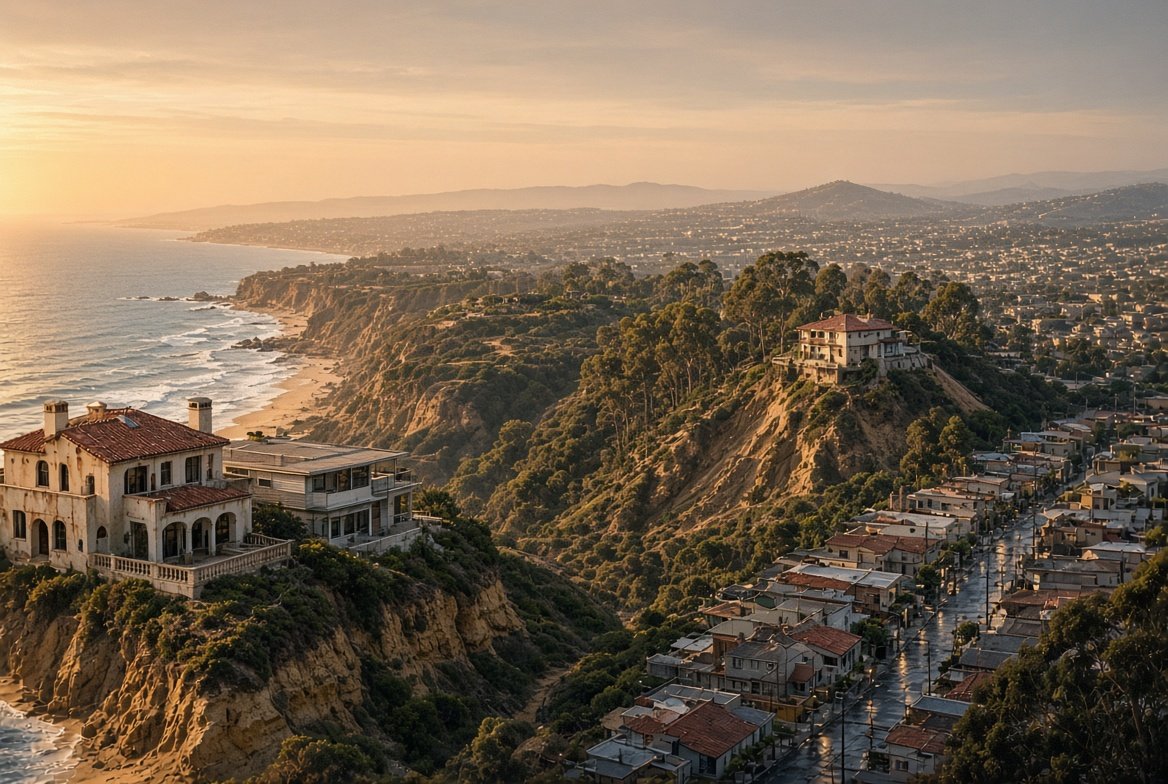
San Diego County spans coastal communities, inland valleys, canyon hillsides, and dense urban neighbourhoods, and each brings its own property risks. Claims here reflect that variety, which is why local experience matters more than it might in a more uniform market.
The Conditions That Shape San Diego Claims
A public adjuster in San Diego encounters a recurring set of regional factors:
- Coastal exposure, where salt air accelerates corrosion in plumbing, fixtures, roofing, and building systems, and where insurers may attribute failures to wear rather than a covered event
- Wildfire and smoke risk in the inland and canyon areas, including ash and smoke damage reaching properties well outside any burn perimeter
- Older Spanish and mid-century housing stock, where repairs frequently trigger building code upgrade requirements that are themselves a covered cost under many policies
- Seasonal rain events producing roof and water intrusion claims concentrated into short periods, when insurer adjuster capacity is stretched
- Hillside and canyon properties, where soil movement and drainage issues complicate causation on structural damage
Where Regional Knowledge Changes the Settlement
Two of these factors deserve particular attention. Corrosion in coastal properties is one of the most common grounds insurers use to challenge plumbing and roofing claims, and separating a sudden failure from long-term deterioration requires documentation rather than argument. Code upgrade coverage in older homes is the other, because bringing a damaged property up to current standards can add materially to a rebuild, and that entitlement is routinely unclaimed by policyholders who do not know it exists.
Local construction and labour pricing matters as well. Estimates built on broader regional or national data tend to fall short of what San Diego contractors actually charge, and closing that gap requires local pricing evidence presented as part of the claim.
Working With Local Representation
A public adjuster in California is licensed under the Insurance Code and represents the policyholder, not the insurer [1]. Licence status is public record through the Department of Insurance and should be verified before any engagement [2].
The state’s claims regulations require insurers to acknowledge a claim within 15 calendar days and reach a coverage decision within 40 days of receiving proof of loss [3]. Those timelines matter most when adjuster capacity is stretched after a storm or fire event, and a complete submission is what keeps a claim moving. Allied Public Adjusters works across San Diego County on residential and commercial losses, with an initial review at no cost.
After a Regional Event
When a storm or fire affects a large part of the county at once, insurers process a surge of claims simultaneously. Assessments get scheduled further out, contractors book up, and material costs rise with demand. Policyholders who submit complete, well-documented claims early tend to move through that backlog faster than those who submit partial claims and supplement them later. In a surge period, documentation quality is effectively a scheduling advantage as well as a settlement one.
Common Questions
Does coastal corrosion void a plumbing or roof claim? Not automatically. The question is whether the failure was sudden, and documentation of the failure point is what answers it.
Are code upgrade costs covered on older San Diego homes? Many policies include ordinance or law coverage. Whether it applies depends on the specific policy, which is why the declarations and endorsements should be reviewed.
Key Takeaways
| 1 | Coastal corrosion is a common basis for insurers to challenge plumbing and roofing claims in San Diego. |
| 2 | Code upgrade entitlements in older housing stock are frequently unclaimed by policyholders. |
| 3 | Smoke and ash damage can affect properties well outside a wildfire burn area. |
| 4 | Local contractor pricing evidence is needed to close the gap with broader estimate data. |
| 5 | Verify any adjuster’s California licence through the Department of Insurance before engaging. |

Daniel J. Morgan is the founder of Invidiata Magazine, a premier publication showcasing luxury living, arts, and culture. With a passion for excellence, Daniel has established the magazine as a beacon of sophistication and refinement, captivating discerning audiences worldwide.


