

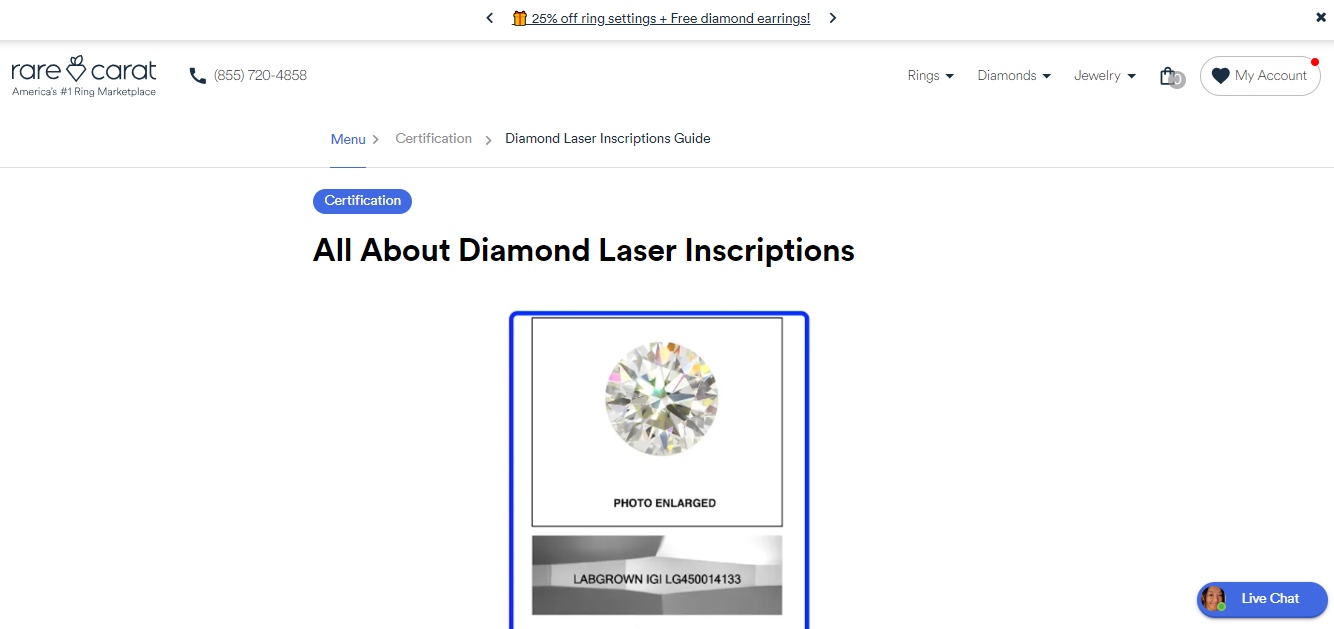
Rare Carat’s digital verification system acts as a reliable bridge between an online gemstone listing and its physical counterpart in the real world. Buying an engagement ring online requires a high level of trust, which is why understanding how platform authentication tools function helps secure your investment and provides complete peace of mind.
Understanding Diamond Girdle Inscriptions and Lab Certification
A diamond laser inscription is an ultra-thin identification number or code etched onto the girdle of a stone using a specialized laser tool.
This microscopic marking serves as an unalterable link between the physical gemstone and its official grading document issued by an independent laboratory like the Gemological Institute of America or the International Gemological Institute. Because the inscription contains the unique report number, it allows buyers and gemologists to confirm that the physical diamond they hold matches the specifications listed on its grading report. This process covers essential grading metrics, including cut quality, color grade, clarity characteristics, and total carat weight, ensuring absolute transparency throughout the marketplace.
Core Mechanics of Rare Carat’s Digital Verification Tool
Rare Carat operates an automated lookup framework that cross-references user-entered certificate numbers and inscription codes against comprehensive gemological databases.
When a shopper evaluates a diamond listing on the platform, the associated certificate number is tied directly into the verification tool. Users can input this unique identifier to pull up live grading data, lab reports, and authenticity markers. The system immediately checks for consistency between the reported stone characteristics and the primary laboratory data, ensuring that no discrepancies exist in the listing details before a purchase is finalized. This digital infrastructure eliminates much of the guesswork previously associated with remote jewelry acquisitions.
Differentiating Between Mined and Lab-Grown Diamond Markings
Laboratory-grown diamonds feature specialized laser inscriptions on their girdles that often include distinct prefixes or explicit labeling to separate them clearly from earth-mined stones.
When verifying stones through platform tools, checking these unique prefixes ensures complete transparency regarding the origin of the gem. For more details on shopping for these specific types of stones, you can read our guide on is shopping from rare carat the best way to buy lab-created diamonds.
Practical In-Person Inspection Using Magnification Tools
Buyers can physically inspect a diamond’s girdle inscription at home by using a standard jeweler’s loupe with at least 10x magnification or a digital microscope.
Because these inscriptions are applied with extreme precision, they remain invisible to the naked eye. This ensures that the brilliance, fire, and structural integrity of the diamond are completely unaffected while still allowing owners to verify the authenticity of their jewelry whenever needed. Knowing how to locate this mark gives consumers an extra layer of control during physical inspections.
Key Benefits of Digital Inscription Verification for Online Shoppers
Verifying diamond inscriptions provides absolute peace of mind by preventing fraud and guaranteeing that the physical stone matches its official grading certificate.
| Verification Benefit | Why It Matters for Buyers |
|---|---|
| Authentication | Confirms the physical stone matches the official certificate. |
| Transparency | Provides clear data sourced from independent gemological labs. |
| Traceability | Allows tracking for insurance, appraisal, and future resale. |
| Protection | Protects against substitution and high-value fraud. |
Potential Limitations and Technical Challenges
Digital verification tools depend entirely on database completeness, laboratory grading accuracy, and the physical readability of the inscription under magnification.
If an engraving is worn, poorly etched, or missing from the database index, automated matching may fail, requiring manual consultation with customer support or independent gemologists to resolve any questions. Understanding these edge cases ensures that buyers remain realistic about what automated software can achieve.
Frequently Asked Questions
What is a diamond laser inscription?
A diamond laser inscription is an ultra-thin identification number or code etched onto the girdle of a diamond using a specialized laser.
Can you see a diamond inscription with the naked eye?
No, diamond inscriptions are microscopic and require a jeweler’s loupe or microscope to read clearly.
How does Rare Carat verify a laser inscription?
Rare Carat matches the report or inscription number entered by a user against comprehensive gemological lab databases to validate stone details.
Do lab-grown diamonds have laser inscriptions?
Yes, most reputable laboratories laser-inscribe lab-grown diamonds with unique report numbers and specific origin labels.
What happens if a diamond inscription cannot be read?
If an inscription is unreadable, experts may need to inspect the diamond under specialized magnification equipment or contact the issuing laboratory.
Are laser inscriptions harmful to the diamond?
No, laser inscriptions are extremely shallow and do not affect the structural integrity, durability, or sparkle of the diamond.
Is Rare Carat’s verification tool free to use?
Yes, shoppers can freely access certificate lookup and verification features on the platform.
Disclaimer: Inscription verification details and database features may change over time. Readers should always verify final purchase information directly through official platform resources before making a transaction.


